Welcome to the website of the Complex Matter and Nonlinear Physics Laboratory at Clark University. We seek to discover the physical principles that govern systems driven far from equilibrium, where energy, matter, or information continually flow through the system and give rise to complex dynamical behavior. Such systems include active biological matter, soft robotic systems, granular and porous media, fluid-structure interactions, and evolving materials.
Unlike systems at thermal equilibrium, which can often be understood through established frameworks based on entropy maximization and free-energy minimization, nonequilibrium systems exhibit rich dynamics, history dependence, and self-organization that remain only partially understood. Our research aims to uncover the fundamental mechanisms by which collective behavior, pattern formation, memory, transport, and adaptation emerge from local interactions.
To address these questions, we combine laboratory experiments, advanced imaging, theoretical modeling, and machine learning approaches to study a diverse set of systems ranging from living organisms and robotic materials to subsurface flows, sediment transport, and climate-relevant geophysical processes. Through these model systems, we seek broadly applicable principles governing complex matter across scales.
Current research
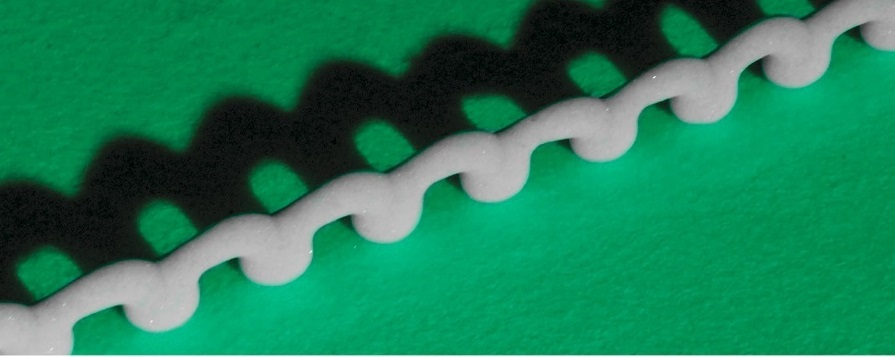
- Soft Robotic Locomotion in Complex Media Understanding how flexible robots swim, burrow, and navigate through fluids, sediments, and multiphase environments.
- Living Active Matter Investigating navigation, collective behavior, and self-assembly in biological systems such as California blackworms.
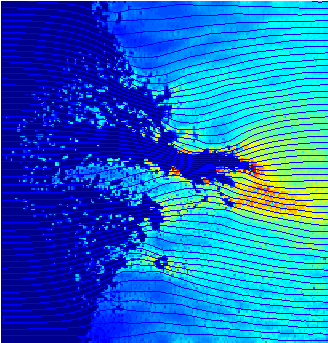
- Subsurface Flow and Porosity Evolution Developing physics-informed machine learning models to predict how transport, erosion, and geochemical processes reshape porous materials relevant to carbon storage, groundwater flow, and energy resources.
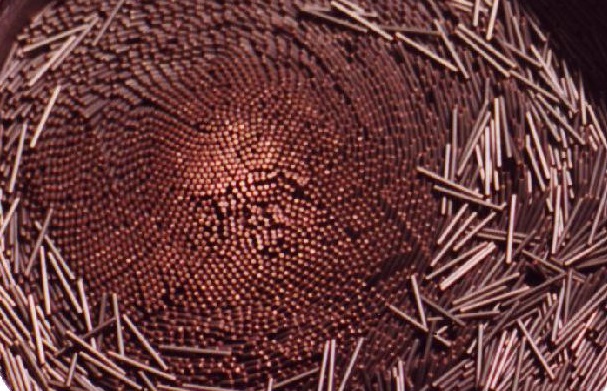
- Filament Bundling and Structural Mechanics Exploring how twisting and confinement drive the self-assembly and mechanical response of elastic filament networks.
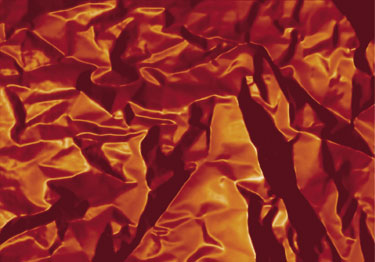
- Crumpling, Folding, and Mechanical Memory Studying how thin sheets evolve under repeated deformation and how disordered materials encode and retain mechanical information.
- Melting Ice Dynamics Investigating how melting-induced flows influence the motion of floating ice bodies and contribute to iceberg transport in natural environments.