Current Projects
- Soft Robotic Locomotion in Complex Media: We study how soft, flexible robots swim, burrow, and maneuver through deformable materials, including sediment beds and multiphase environments. By combining experiments, imaging, and modeling, we seek to understand the coupling between body deformation, medium fluidization, and propulsion, and how these interactions can be used to improve robotic mobility in challenging terrains.
- Living Active Matter: We investigate how California blackworms use body deformations and local interactions to navigate heterogeneous environments and self-assemble into dynamic collectives. Our research seeks to identify the physical rules that govern collective motion, entanglement, and emergent organization in living systems, providing insight into active matter far from equilibrium and inspiring the design of adaptive robotic swarms and self-organizing materials.
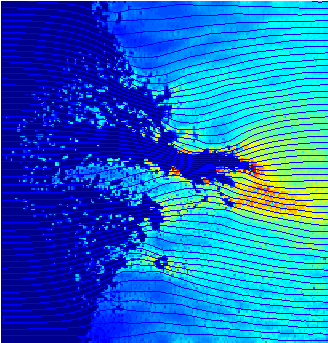
- Subsurface Flow and Porosity Evolution: We develop physics-informed neural networks to study how fluid-driven transport, erosion, and geochemical processes alter porosity and permeability in subsurface materials. By integrating physical constraints with experimental and imaging data, we aim to uncover the fundamental mechanisms governing the evolution of porous media and improve predictions relevant to carbon sequestration, hydrocarbon extraction, groundwater resources, and geologic erosion.
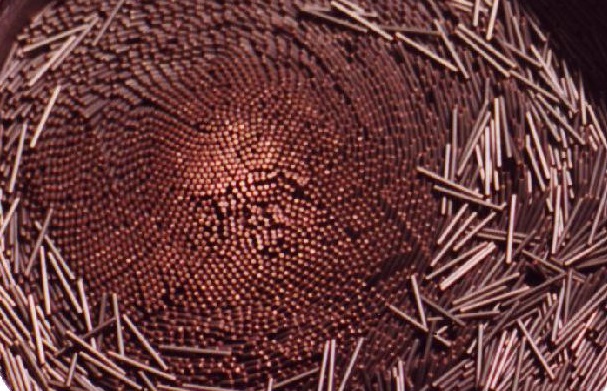
- Filament Bundling Mechanics: We explore how twisting drives the assembly of elastic filaments into three-dimensional bundles with rich geometric and mechanical properties. Understanding the interplay between elasticity, topology, and packing may provide insights into biological fibrous materials, engineered filament networks, and the design of twist-responsive structures.
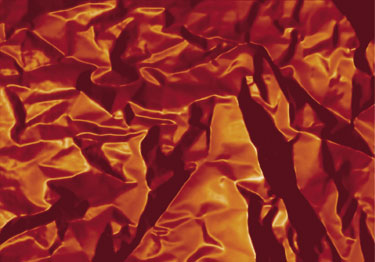
- Crumpling and Memory in Thin Sheets: We study how repeated crumpling creates and reorganizes crease networks in thin sheets, leading to memory, aging, and irreversible structural changes. By combining experiments and modeling, we seek to understand how complex folding pathways emerge and how mechanical information is encoded in disordered materials.
- Melting Ice Dynamics: We investigate how melting and buoyancy interact to generate self-propulsion of floating ice bodies in fresh and salt water. Understanding these processes may improve predictions of iceberg transport and the response of polar and ocean environments to climate change.